Overcoming Communication Palisades: Part One

Yesterday I posted a laundry list of various Communication Palisades.

Obviously there are hundreds of ways you can go and tweak each individual one. For the sake of this post, I will share with you the four step process to overcoming any and all of the communication palisades.

Step one: Whether it is before the communication takes place or after, to overcome the obstacles of communication, you must begin (or re-start) by focusing on preparedness and design. This involves returning to the source and encoding steps of the Shannon-Weaver Model. Is your message as specific as possible? Have you chosen the medium of encoding and the channel with the least amount of noise?

Step two: This step is about running ladders in conversation. At every distance, implement a reminder of the source of where the communication originated as well as the reason for communication. This frequent return not only strengthens the connection of communication, but it allows you to maintain the focus as much as it communicates it to the receiver.

Step three: Communication has to have a certain vivacity to it. Communication isn’t effective if it does not get others enthused, excited, interested, and maybe even a little bit turned on… at your ideas. This third step is vital for those who are communicating something bland, something generic that it’s even hard for you to be interested in. As a PR Specialist, there will be times that you have to swing something, but in a positive sense. What makes the swing negative is when you fake your enthusiasm, when you channel deceitful excitement. A true PR professional will work on convincing themselves of the subjects animation before expressing it to another.

Once you convince yourself, it’s much easier to convince others.

Step four: Flirt with benefits. Communication is a transaction and as you can imagine, the only transactions that seem to “work themselves out” are the ones where the other person feels they are getting a huge benefit out of it. Ask yourself, how can you benefit them? But don’t just answer it yourself, tell them!

Whether you are analyzing your communication strategy before it takes place or revisiting ways to strengthen a communication attempt you have already made, following these four steps will get you past almost every barrier.

The most important variable to consider while taking these steps is to be human. Be real. Be honest. Be caring. But above all, just be human.

The “IOU” Paradox And How To Best Give

I give a lot. I love to give, I mean, really really love to give. Time, money, resources, tools, and so on, I give it all to those who ask, and even more to those who don’t.

What I can’t stand are the reactions I get when I give – the old “IOU”. Every time I give, it comes out in some shape or form. Here are some examples? Do they sound familiar?

“I’ll pay you back”

“Next time, I’ll get it”

“Why don’t you take this since you are giving me that

and the worst of all, the “IOU”

Not to start a debate -by all means go ahead if you want- people are naturally good. There are very few people who I have given to that when I continuously asked why they thought they owed me, they came up with a statement which basically said that since I gave to them, they felt they needed to give to me. Balance. Those are good people, but oh so very annoying.

People may be naturally good, but they are also naturally and extremely self-centered. So self-centered that they care more about the need for that balance of giving back to the person who gave to them, than they do the simple fact that the person who gave to them, does not want anything in return. You are insulting the person and degrading the bliss they feel for giving without that expectation when you fulfill an expectation that is not there.

That is all fine and dandy, human nature, all of which you have experienced yourself or can rightly agree with.

But then someone comes along and doesn’t praise you for giving without an expectation, doesn’t say the infamous words of IOU, takes what you gave and never mentions it again. This is where the IOU paradox presents itself.

Despite the ever-present blissful feeling of giving without an expectation of a return, you feel swindled. You question whether they know you gave to them because you cared about them, that you felt their was an invisible but mutual respect for one another, you thought that them not giving you an IOU would make you feel even more incredible, but sadly… it doesn’t.

There’s no winning, but you still have two options. Either you can deal with them never mentioning your gift again, or you can convince them of how deserving they are of it so they don’t feel that it’s a gift, rather, an award for living remarkably.

I prefer the latter.


Stay Positive & Want An Award? Who doesn’t?

Garth E. Beyer

Communication Palisades

Here is a list of communication palisades, or barriers, which arise in every day life and professional work. Try to imagine specific examples that the barriers have shown up in your life, both for you or your client(s).

  • Already tangled or broken lines of trust and committment
  • Inconsistency
  • Physical barriers
  • Gender, age, degree
  • Hypocrisy
  • Physical behaviors
  • Language, enunciation differences, volume strain
  • Information overload
  • Poorly influenced
  • Audience enthrallment
  • Time crunch
  • Distractions/Noise
  • Woeful retention rates
  • No eye contact
  • Attitude
  • Presentation of information
  • Lack of credibility
  • Sentinels

We will take a look at overcoming these communication palisades tomorrow.

Re: A Manual For Daily Adventure Pt.2

The 2nd round was just as fun and adventurous (in an even more unique way) as the first. If you’re just catching up, I’m working on Michelle Welsch’s A Manual For Daily Adventure. She has provided 80 ways to get started shaking things up in your life. I have done four already and including the one’s I am reporting today, I have 62 more adventurous activities to partake in!

36. Concentrate on nothing except pouring yourself a cup of tea

67. Hide a note for your partner to find (I no longer have a partner so I have written a note for my future partner to find when we kick it off)

24. Stare out the window (How can I not with the view I have over Lake Mendota?)

19. Write a pageful of questions. Don’t worry about answers.

33. Compliment a stranger. (A girl who I recognized from seeing at school pulled her tank-top up really high at the mall. As she walked by I had overheard her and her friend questioning whether it looks good or not -obviously sarcastically, likely making fun of someone- and I replied, “that looks good”. They were zoned out and probably didn’t hear me, if they did they probably gave me a really dirty look as I kept walking. #awkward)

46. List 4 things you are thankful for in this moment. (I typically list five things every night before sleep, but as I read this “to-do adventure”, I pulled my Gratitude Notes out and wrote down: sleepless nights worth staying awake for, sunlight, good tasting water -didn’t get my brita pitcher yet-, deep conversations that lead to action)

47. Pick up your favorite book and head to the park. (I wrote this post in response to taking this action.)

52. Set a new fitness goal. (I decided to have a goal of 50 pull-ups, I can already do 25 which means I’m already half way there!)

11. Stroll through a book store and notice which section pulls you in. (At first I started walking to the New Age Thinking section, but then my feet took me directly to the Writing Reference section. From there I was pulled to old classic novels and from there to Seth Godin’s books. I hoped to end up walking to something new, but what pulled me in is currently relevant to my life.)

17. Start a scrapbook with images you tear out of magazines, newspapers, funny office memos. (I prefer using my huge tack-board as a replacement for a scrapbook. I’ve filled it up much more since I took this picture)

18. Schedule a coffee date with someone you admire. (Scheduled a coffee date with Katie Christensen, entrepreneur and great friend to discuss business ideas and upcoming events.

68. Put your other shoe on first.
I actually didn’t know which shoe I put on first, so I did both… Overachiever?

34. Brush your teeth with opposite hand. (Weird, but not difficult)

69. Be a slob. Don’t make the bed. Leave it on the floor. (This slobbish enough?)

Stay Positive & Always A Bit Awkward

Garth E. Beyer

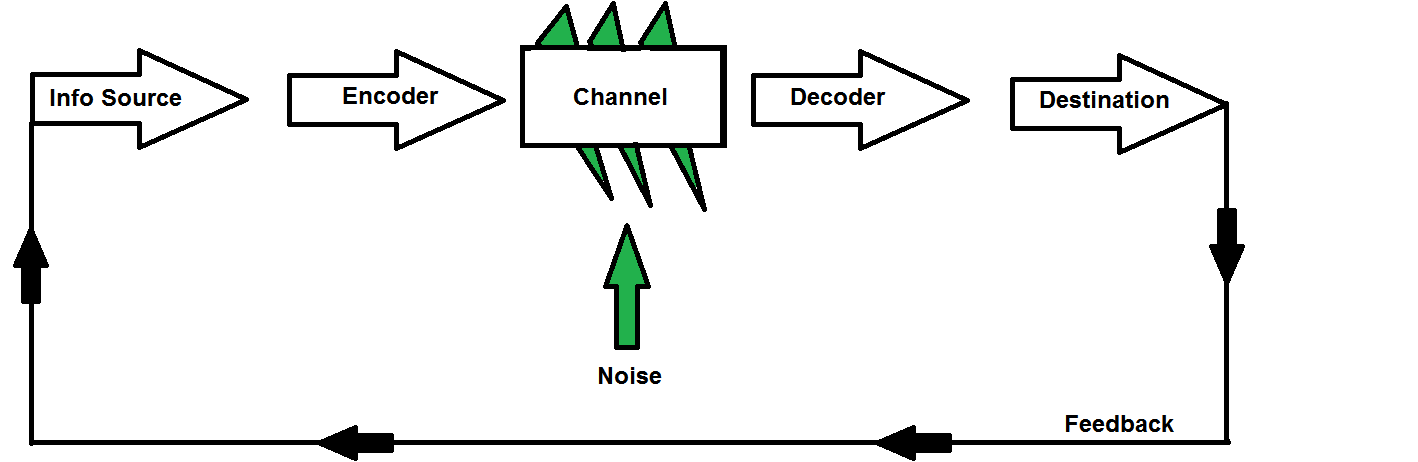
The Shannon-Weaver Model

The Shannon-Weaver Model, also known as the Linear Communication Model and the Mathematical Theory of Communication, demonstrates the process of communicating. It also helps you realize why the most effortless acts of communication can result in complete misinterpretation or misunderstanding.

It was in 1947 that Claude E. Shannon created this theory with the intention for it to be used in facilitating information transmission over telephone lines. Not surprisingly, it took on an entirely new role of being one of the most largely used inter-personal communication models to this day.

The model contains 8 key components: Source, Encoder, Message, Channel, Noise, Decoder, Receiver and Feedback.

Source: The source of communication is an individual creator or group of individuals who have a message they wish to be received by another individual or group. The source, or origin of the message, must also have a definite purpose of initiating the communication model.

Encoder: The encoder, also referred to as the sender or transmitter, puts the message into specific signals that will later be interpreted. The encoder must choose distinct forms of signals to represent the meaning of the message clearly.

A gesture of a handshake can be encoded as an image, but it would not work as effectively if it were put into a text format.

Message: The message is the content that is being communicated from one end of the model to the other. Naturally you will send multiple messages that are precise, rather than a single message which has too many meanings.

Channel: The channel is the path on which the message travels. The encoder, while deciding how to best transmit the message, must also consider the best path on which the transmitted message will travel. This channel can be any medium such as magazine, radio, film, internet, etc,.

Noise: Inevitably the channel is already filled with noise; anything that interferes with the transmission of the message. This can be the radio playing too loudly in the background or the encoder’s own inability to enunciate correctly.

Decoder: The decoder simply does the opposite of what the encoder does. The decoder interprets the original message in a way that the receiver will understand. Additionally, the decoder will act as a filter in the sense that the message will have as much noise removed as possible.

Receiver: The receiver is the individual or audience whom the sender had the intention to deliver the message to.

Originally the linear model of communication had stopped there. It wasn’t until Warren
Weaver worked on the fundamentals of the model and added a necessary component. Weaver made the effect of the model orbicular in the sense that he had attached feedback to the model. *See image above.

Feedback: Feedback is the receivers response to the message. The feedback’s intent is to let the encoder know exactly how accurately the message was interpreted as well as simply reporting whether the message was received or not.

Feedback allows the once linear model to become cyclical so that each party – the individual or group at each end of the model – can continue communication.

As an example, we will stick to the model’s origin by using the telephone.

You, the source, wish to convey the message that you have completed the report early to your boss. The message is then encoded as a voice message into the phone, with the phone, or the phones cable being the channel on which the message is traveling. The noise present is simply your daughter screaming in the background as you were working from home this evening. The decoder will present the message as a voice message for the receiver, your boss, to listen to. Your boss will than reciprocate the process and present you with feedback, whether that is simply telling you that you did a good job or hinting at a promotion in the future.

Your Insufflation

Life is not measured by the number of breaths you take, or even the number of moments that take your breath away.


It’s the passion you have that keeps you breathing.


Stay Positive & Breathe More

Garth E. Beyer

What You Deserve

Life is not centered at giving you what you need, you’re on your own with that.

It is however, very much focused on giving you what you deserve. And so am I.

Sure it’s smart to separate your wants and needs, but for this particular case, let’s put them all in one and just call them needs. After all, everyone gets them confused anyway.

Is it safe for me to say that you have never received anything you needed for no reason? As much as we, as humans, fight the assumption, every choice we make is made on the justification that it somehow benefits us. While some people lean towards selflessness like Mother Teresa and others are predominately selfish like Hitler, it is never one or the other, both made the choices they made because it benefited them.

If prodded long enough as to why someone did what they did, it is inevitable to get a response which states that.

Typically unbeknownst, when you receive something you need, you receive it because you have worked for it – except, that you actually never worked for it, you worked for the person to give you it. Again, you are usually unaware that you have worked or will work in a way that will benefit the person who is giving you what you need. Obviously then, the bigger the need, want, desire, hope, and so on that you have, the harder you have to work.

Want to be on the ballot for the next presidential election? You have to work hard for an extremely long time and the hard work you do has to benefit as many people as possible in the largest of ways. The same goes if you want to be a successful businessperson. The same goes if you want to win the Nobel Peace Prize. Anything major in life requires major work. None of it will be given to you unless you provide the gift bearer ways that it would benefit them.

Then, while you are working hard, working smart, working more efficiently through the good and bad times in order to get what you need, life – and all it’s magic – steps in and gives you exactly what you deserve.

However, what most people fail to understand is that you can go through life working hard and never get what you deserve because to get what you deserve, you have to work on your character. What builds character? I think you can figure that one out by yourself.

In my opinion, and I am curious if you agree, I would rather go through life getting what I deserve than what I need/want/desire.


Stay Positive & Work On Yourself And Everything Else Will Come To You

Garth E. Beyer